Service · Clearwater, FL
Tree Trimming and Pruning in Clearwater
Proper pruning is about more than shape. Our ISA-certified arborists trim for structural strength, canopy health, and hurricane-season wind resistance, using techniques that keep your trees looking natural, not butchered.
Trimming and pruning that strengthens trees, not just shapes them
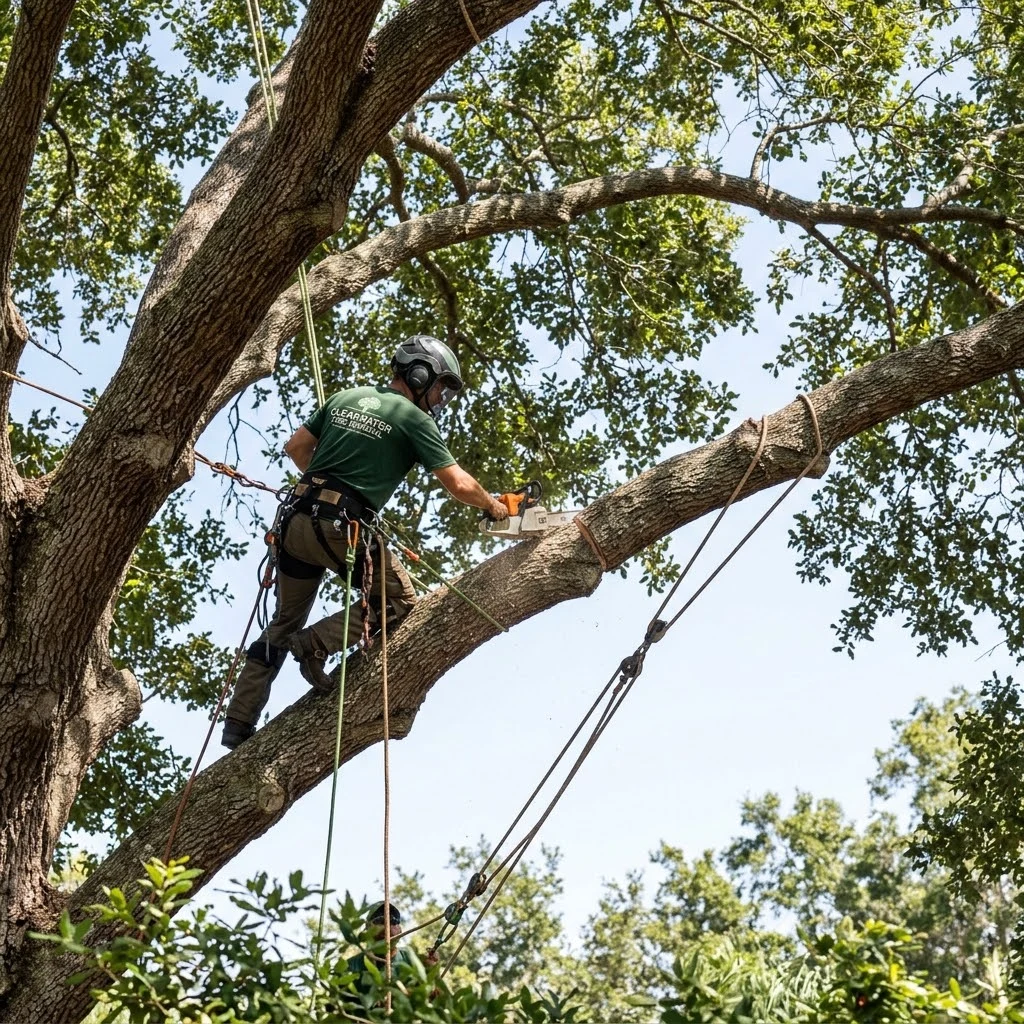
There is a real difference between cutting branches off a tree and pruning it correctly. Bad pruning, especially the topping or lion-tailing you see from unlicensed crews, weakens a tree's structure, triggers weak sprout growth called epicormic shoots, and often shortens the tree's life. Our arborists prune according to ANSI A300 standards, making cuts at the branch collar so the tree can seal the wound properly, and removing no more than 25 percent of live canopy in a single visit so the tree isn't shocked. We also look at the whole tree's history before making a single cut, prior storm damage, previous poor pruning by someone else, soil compaction near the root zone, and current disease pressure all factor into how aggressively we can safely prune without pushing the tree past what it can recover from.
In Clearwater, pruning is also a hurricane preparation tool. A well-structured canopy with reduced wind sail and properly spaced scaffold limbs sheds wind far better than a dense, uncorrected canopy, and it is the single biggest factor in whether a tree survives a tropical storm standing or ends up on your roof. We typically recommend a structural pruning cycle every two to three years for mature shade trees, more often for fast growers.
What's included in a trimming and pruning visit
- Deadwood removal — dead, dying, and broken limbs cut back to live wood or the branch collar.
- Canopy thinning — selective limb removal to reduce wind resistance and let light and air through, without over-thinning.
- Crown raising — lower limbs cut back for driveway, roofline, or walkway clearance.
- Structural pruning — correcting co-dominant stems and weak branch unions before they become failure points.
- Full cleanup — all cut material chipped and hauled, yard raked and blown clean.
What tree trimming costs in Clearwater
Cost depends on tree height, canopy density, and how much climbing or rigging the job requires. A single ornamental crepe myrtle might be $150, while a mature 60-foot live oak needing full structural pruning and crown reduction can run over $1,000. Multi-tree jobs usually come with a per-tree discount since setup and cleanup are shared across the visit.
| Job | Typical range | What moves the price |
|---|---|---|
| Small ornamental (under 20 ft) | $150 – $350 | Number of trees and access |
| Medium shade tree (20–45 ft) | $300 – $700 | Canopy density and climbing required |
| Large mature tree (45 ft+) | $600 – $1,500 | Structural work vs. light trim |
| Deadwooding only | $200 – $500 | Amount of dead material in canopy |
| Crown raising for clearance | $250 – $600 | Number of limbs and target height |
| Multi-tree property discount | 10% – 20% off | Number of trees on the visit |
How often should you trim your trees?
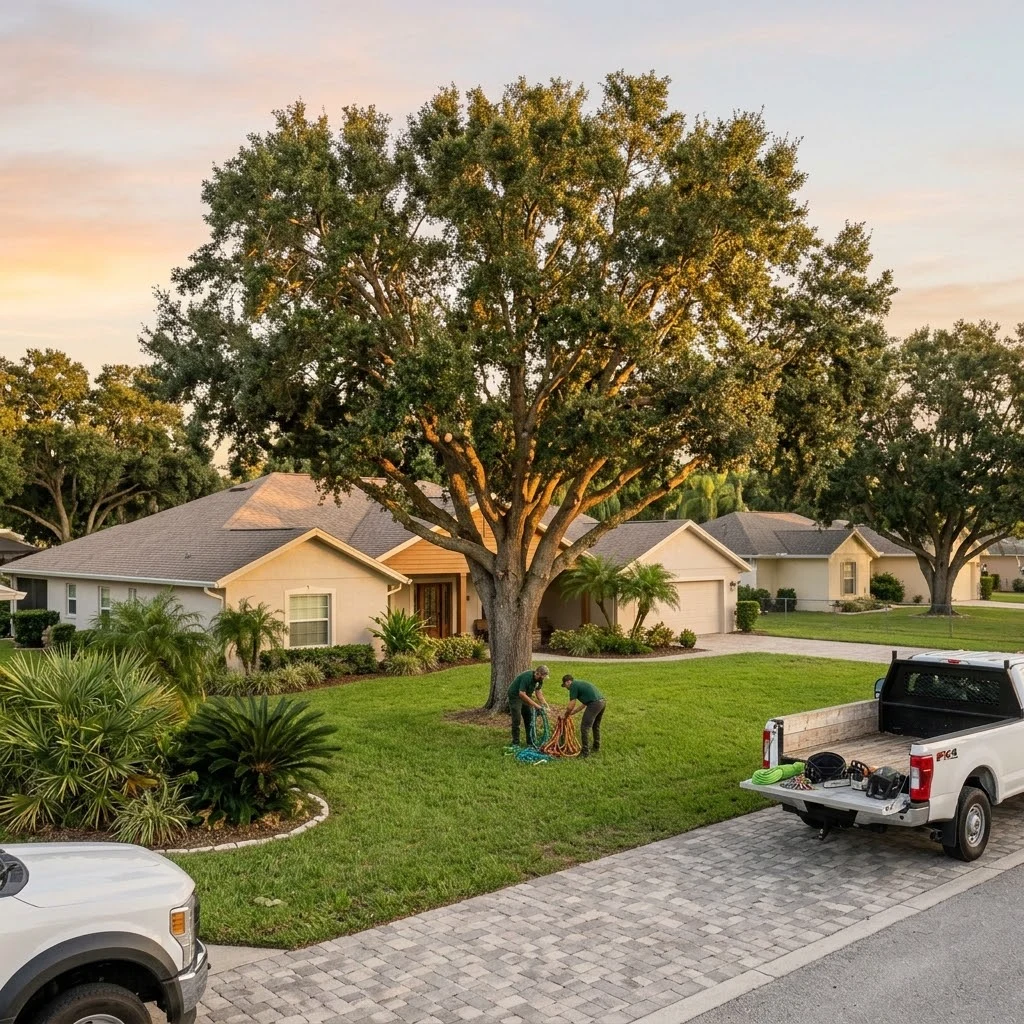
Fast-growing species like laurel oak, Chinese elm, and tabebuia often need attention every one to two years to manage weak branch unions before they become structural problems. Slower, denser species like live oak and Southern magnolia typically do well on a two to three year structural pruning cycle. Palms are different entirely and are usually trimmed once or twice a year, see our palm tree trimming page for that schedule. If it's been more than three years since your trees were professionally pruned, a canopy assessment before hurricane season is worth scheduling.
Our pruning technique and standards
We follow ANSI A300 pruning standards and ISA best management practices on every job. That means cuts are made just outside the branch collar, never flush to the trunk, so the tree can compartmentalize the wound naturally. We avoid removing more than a quarter of live foliage in one visit, we prioritize removing crossing and rubbing limbs and codominant stems with included bark before purely cosmetic cuts, and we never use climbing spikes on a tree that isn't being removed, since spikes wound the cambium layer and create entry points for decay and disease. Every cut is also made with the tree's final silhouette in mind, we work to preserve a natural branching pattern rather than leaving an obviously hacked or lopsided canopy, which is a common complaint homeowners have after hiring an unlicensed crew.
Where we do this work
We trim and prune residential and commercial canopies throughout Pinellas County, including established tree canopies in Clearwater, coastal properties in Dunedin, and neighborhoods across Largo and Palm Harbor. Check our full service area to confirm we cover your city.
Questions
Tree Trimming and Pruning FAQs
Small ornamentals typically run $150 to $350, medium shade trees $300 to $700, and large mature trees $600 to $1,500, depending on canopy density and how much climbing or rigging is needed. Multi-tree properties usually get a per-tree discount since equipment setup and cleanup costs are shared across the visit.
In practice the terms overlap, but pruning generally refers to targeted, structural cuts made for tree health, like removing codominant stems or crossing limbs, while trimming is often used for general shaping and clearance work. Our arborists do both in the same visit: structural correction where the tree needs it, and shaping and clearance where you want it.
We follow the ISA guideline of removing no more than 25 percent of live canopy in a single pruning visit, and often less on stressed or older trees. Removing more than that in one cut cycle can shock the tree, trigger excessive epicormic sprouting, and weaken its overall vigor for a season or more.
No. Topping, cutting main scaffold limbs down to stubs, creates weak, poorly attached regrowth and interior decay pockets that make the tree more hazardous over time, not less. If height reduction is genuinely needed for clearance or wind resistance, we use crown reduction, which cuts back to lateral branches large enough to assume the terminal role, preserving the tree's natural form and structure.
Most species can be pruned year-round in Florida's climate, but the ideal window for structural work is late winter into early spring, before the spring growth flush and ahead of hurricane season. Flowering trees like crepe myrtle are best pruned right after bloom so you don't cut off next season's flower buds.
Yes, this is one of the highest-value services we offer. Thinning a dense canopy reduces wind sail, removing deadwood eliminates the projectiles most likely to become debris, and correcting weak branch unions reduces the chance of limb failure in sustained wind. We recommend scheduling by late May, before the June 1 start of Atlantic hurricane season.
Correct pruning, made at the branch collar with clean cuts and without over-thinning, causes minimal stress and the tree seals the wound naturally within one to two growing seasons. Improper pruning, flush cuts, topping, or removing too much canopy at once, is what actually damages trees, which is why technique and restraint matter more than how much gets cut.
For trees near but not touching primary service lines, yes, our crews are trained in utility line clearance procedures. For limbs actually in contact with primary power lines, we coordinate with Duke Energy, since de-energizing or clearing that specific zone falls under utility company procedure rather than standard tree service work.
Both. We handle individual specimen pruning as well as row and screen trimming for hedges, viburnum rows, and privacy screens, maintaining a consistent line and density across the whole row rather than pruning each plant independently, which is what usually causes an uneven, patchy look.
Yes, cleanup is included in every trimming job. Cut material is chipped on site or hauled away, and we rake and blow the work area before we leave. If you want the wood chips left as mulch for your beds, just let the crew know and we'll pile it where you want it instead of hauling it off.
Selective thinning generally does not cause denser regrowth if cuts are made correctly at lateral branches. Heavy, indiscriminate cutting or topping, on the other hand, often does trigger a flush of weak, dense epicormic shoots as the tree tries to replace lost foliage quickly, which is one more reason we avoid aggressive over-pruning.
Yes, many Clearwater customers set up a two to three year structural pruning cycle for mature shade trees, or annual visits for fast-growing species and palms. We'll recommend an interval based on the specific species and growth rate on your property when we do the first visit, and can put you on a reminder schedule.
Related
Other tree work we do
Get a price for your tree trimming and pruning
Free on-site estimate with a flat written price before we start. Call or send photos and we will tell you what it costs.
Mon–Sat 7:00am–7:00pm · Licensed & insured · Serving Clearwater, Dunedin, Palm Harbor & Largo