Service · Clearwater, FL
Palm Tree Trimming and Removal in Clearwater
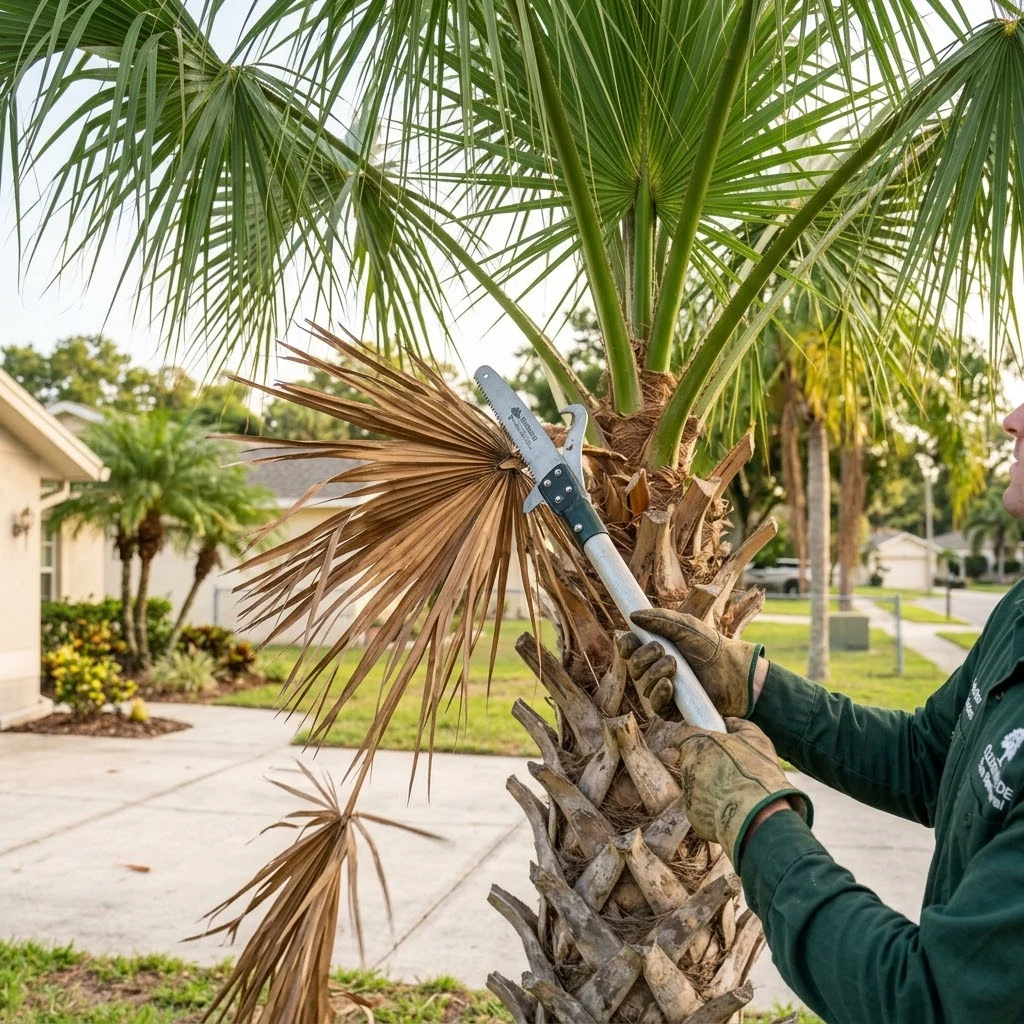
Palms need different care than hardwood trees. We trim fronds and boots correctly to protect the crown, clear away rat's nest buildup, and remove palms safely when they've outgrown their space or died.
Palm care that respects how palms actually grow
Palms are not trees in the botanical sense, they're more closely related to grasses, and that changes almost everything about how they should be maintained. A palm has a single growing point, the apical meristem or "heart," at the very top of the trunk. Damage that point and the palm dies, no regrowth, no recovery, unlike a hardwood that can push new growth from almost anywhere on a wounded limb. That's why over-trimming, cutting live green fronds close to the crown, is not just cosmetically bad, it genuinely weakens the palm's ability to photosynthesize and can shorten its life.
Clearwater's palm population runs heavy on Sabal palms, our state tree, along with queen palms, Washingtonians, and coconut palms on the more sheltered, warmer lots. Each has slightly different growth habits and boot (the fibrous frond base) retention, which changes how we approach trimming. Sabals naturally self-clean by dropping old fronds and boots over time, while queen and Washington palms tend to hold dead fronds and need more frequent manual trimming to avoid the dense, unkempt "skirt" that becomes both a fire hazard and a rat harborage.
What's included in palm trimming
- Dead and dying frond removal — brown, hanging, and disease-showing fronds cut back to the trunk without damaging the boot.
- Seed pod and flower stalk removal — heavy seed pods removed before they drop, which reduces mess and eliminates a real falling hazard.
- Crown cleaning — old boots, debris, and rat's nest material cleared from the crown where pests commonly den.
- Hurricane cut option — light, conservative frond thinning ahead of storm season, done without over-trimming the canopy.
- Full cleanup — fronds and debris chipped or hauled from the property same day.
What palm trimming and removal costs
Price is driven mostly by height, since taller palms need more climbing time or bucket truck access, and by how overdue the palm is for trimming, a palm with years of accumulated dead fronds and heavy seed pods takes longer than one on a regular maintenance cycle. Removal pricing follows similar logic: height and trunk diameter drive most of the cost, with disposal of the trunk section, which is heavy and doesn't chip like hardwood, factored in separately.
| Job | Typical range | What moves the price |
|---|---|---|
| Palm trimming, under 20 ft | $150 – $250 | Height and frond count |
| Palm trimming, 20–40 ft | $250 – $450 | Height and access, climbing vs. bucket truck |
| Palm removal, under 30 ft | $200 – $400 | Trunk diameter and disposal |
| Palm removal, 30 ft+ | $350 – $600 | Height, access, and trunk weight |
| Seed pod/flower stalk removal | $50 – $150 | Number of stalks |
| Multi-palm property discount | 10% – 20% off | Number of palms trimmed same visit |
When does a palm need to be removed instead of trimmed?
A palm should come down when the trunk shows conking (fungal fruiting bodies indicating internal rot), when the crown has died back with no new spear leaf emerging, which usually signals the growing point itself has been killed by lethal bronzing or fatal yellowing disease, or when a lean has progressed to the point of root plate instability. Palms with ganoderma butt rot, visible as a shelf fungus low on the trunk, are also removal candidates since there's no effective treatment once the fungus is established. If your palm just looks a little ragged or overgrown, that's almost always a trimming fix, not a removal situation. We'll tell you honestly which category your palm falls into rather than pushing removal when a routine trim and a fertilizer correction would solve the problem just as well.
How we climb and access tall palms safely
For most residential palms we climb using spikes and a friction saddle, which is safe for palms since, unlike hardwoods, palm trunks don't have living cambium tissue that spikes can damage, there's no bark to wound in the way there is on an oak. For very tall palms, over roughly 40 feet, or clusters of palms close to power lines or structures, we bring in a bucket truck instead, which is faster and keeps our crew clear of the frond zone where sharp petiole edges and falling seed pods pose the most risk.
Where we do this work
We trim and remove palms throughout Pinellas County, including coastal properties in Clearwater and Dunedin, and residential streets in Largo and Palm Harbor. See our full service area for every city we cover.
Questions
Palm Tree Trimming and Removal FAQs
Palms under 20 feet typically run $150 to $250, and taller palms from 20 to 40 feet run $250 to $450, depending on frond count and whether climbing or a bucket truck is needed. Multiple palms on the same property usually get a per-palm discount since equipment setup is shared across the visit.
Most Clearwater palms do well on a trim once or twice a year, once ahead of hurricane season in late spring, and again in fall or winter if fronds accumulate quickly. Fast-growing species like queen palms may need more frequent attention, while self-cleaning Sabal palms often need less.
A palm has a single growing point at the crown and cannot regenerate fronds the way a hardwood tree can push new growth from a cut limb. Removing too many green, healthy fronds, sometimes done for a stripped "hurricane cut" look, reduces the palm's ability to photosynthesize and store energy, which weakens it and can shorten its life, all without meaningfully improving storm resistance.
A hurricane cut refers to aggressively stripping a palm down to just a handful of upright fronds, and despite the name it does not meaningfully improve storm survival, since it removes healthy tissue the palm needs. We recommend a conservative pre-season trim instead: removing dead, dying, and loose fronds and heavy seed pods, which reduces actual wind-borne debris without weakening the palm.
Removal of a palm under 30 feet typically runs $200 to $400, and taller palms over 30 feet run $350 to $600, driven mostly by height, access, and the weight of the trunk sections that need to be hauled, since palm trunk doesn't chip the way hardwood does.
Watch the newest, innermost frond, called the spear leaf. If it's brown, wilted, or has stopped emerging entirely while older fronds still look normal, that usually signals the crown or growing point has been damaged, often by lethal bronzing disease or physical injury, and the palm may not recover. A shelf-like fungal growth low on the trunk is another strong indicator the palm needs to come down.
Sometimes. Nutrient deficiencies, which show up as yellowing or frizzled newer fronds, are often treatable with a proper palm fertilizer regimen and can reverse over a couple of growing seasons. Lethal bronzing and lethal yellowing, both spread by insect vectors, have no reliable cure once symptoms reach the crown, and ganoderma butt rot has no treatment at all. We assess the specific symptoms before recommending removal.
Yes, accumulated dead fronds and old boots create exactly the dense, sheltered cavity rats and other pests use to nest, especially on queen and Washington palms that don't self-clean. Crown cleaning to remove this material is part of a standard trim and noticeably reduces pest activity around the tree.
Yes, more so than people expect. Falling seed pod clusters and frond bases can weigh significant amounts and drop from real height, petiole edges on some species are sharp enough to cause serious lacerations, and climbing a 30-plus foot palm without proper spikes, saddle, and fall protection is genuinely dangerous. This is one of the more common DIY tree-care injuries we hear about from new customers.
Coconut palms need regular removal of developing coconuts before they mature and drop, both for safety under the canopy and because a falling coconut can cause real injury or property damage. They're also more cold-sensitive than Sabal palms, so we watch condition more closely after any unusual cold snaps in winter.
For palms near but not touching primary lines, yes, our crews are trained in utility line clearance. Palms with fronds actually contacting or growing into primary lines require coordination with Duke Energy before we work in that zone, the same as with hardwood trees.
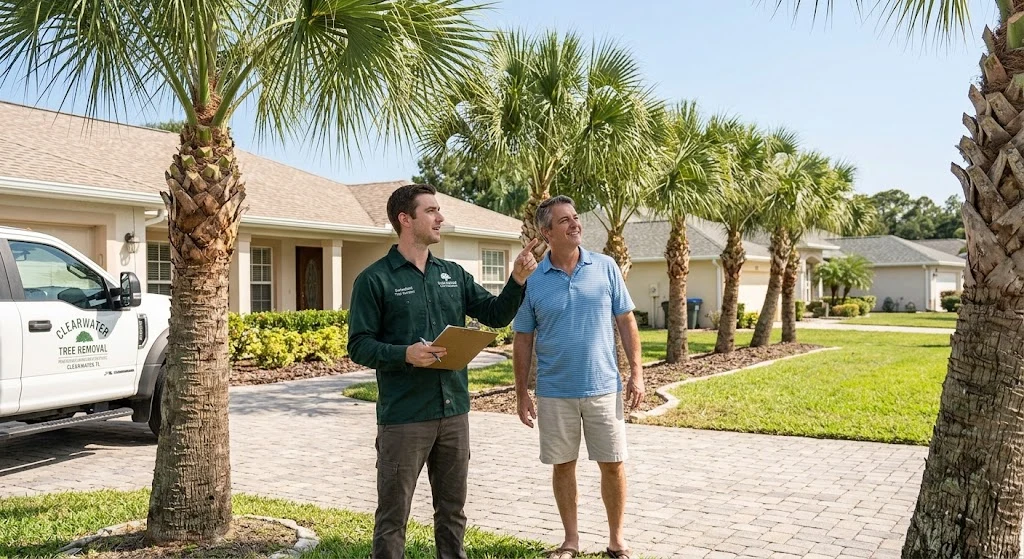
It varies by property, but many Clearwater homes with a row of palms along a driveway or property line have five to ten palms trimmed in a single half-day visit, with multi-palm discounts applied. Larger properties or HOA common areas with dozens of palms are scheduled as a longer job or across multiple visits.
Related
Other tree work we do
Get a price for your palm tree trimming and removal
Free on-site estimate with a flat written price before we start. Call or send photos and we will tell you what it costs.
Mon–Sat 7:00am–7:00pm · Licensed & insured · Serving Clearwater, Dunedin, Palm Harbor & Largo