Service · Clearwater, FL
Emergency Storm Damage Tree Removal in Clearwater
A tree down on your house or car after a storm can't wait. We dispatch priority crews for storm damage across Pinellas County, day or night, with documentation your insurance company will accept.
Fast, safe response when a storm brings a tree down
Pinellas County sits in one of the more storm-exposed corners of the Gulf Coast, and between tropical systems, seasonal thunderstorm downbursts, and the occasional tornado spun off a frontal squall line, trees come down here more often than most homeowners expect. When it happens to your property, the two things that matter most are getting the immediate hazard controlled safely, and documenting everything correctly so your insurance claim isn't a fight. We do both, and we answer the phone.
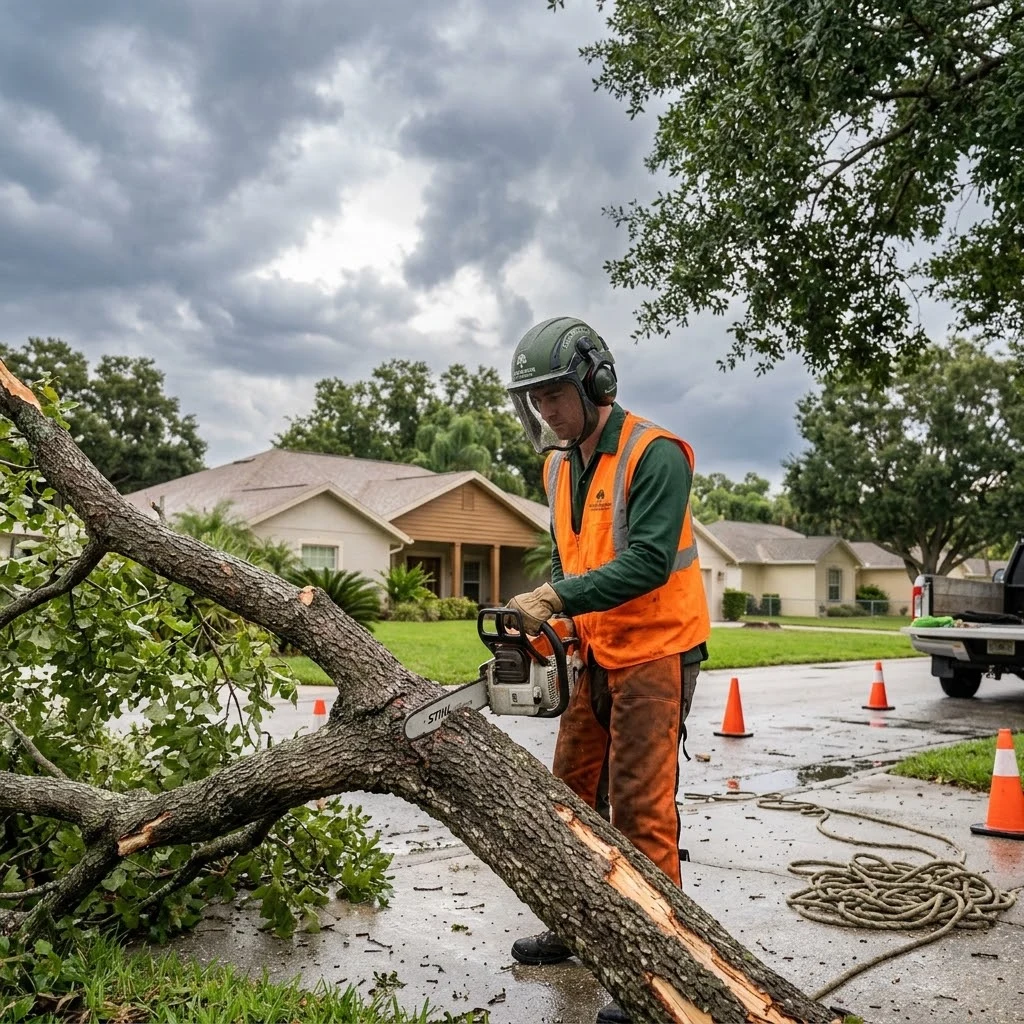
A tree resting on a roof is under load in ways that are not obvious from the ground. Cutting the wrong section first can cause a sudden shift that drives a limb further into the structure or drops weight onto someone below. Our crews assess load paths before cutting anything, often removing canopy weight first to relieve pressure on the structure, then sectioning the trunk from the top down rather than cutting underneath a loaded tree, which is one of the most common ways storm cleanup goes wrong for untrained crews. We also carry the insurance and licensing storm work requires, since some out-of-state crews that show up after major hurricanes are neither properly licensed in Florida nor adequately insured, which leaves homeowners exposed if something goes wrong during the cleanup.
What's included in emergency storm response
- Priority dispatch — storm calls are triaged ahead of routine scheduling, with same-day response for trees on structures or blocking access.
- Safe load-path assessment — before any cutting, we evaluate how the downed tree is bearing weight against your roof, car, fence, or power line.
- Tarping and temporary securing — if full removal has to wait on utility de-energization or daylight, we secure the site and tarp exposed roof sections.
- Insurance documentation — dated photos, itemized invoices, and a written damage description formatted the way Florida homeowner insurers expect.
- Full debris haul-off — trunk, limb, and canopy debris cleared from the property, not just cut into pieces and left.
What emergency tree removal costs
Emergency work costs more than scheduled removal because it often happens after hours, in difficult footing, with added risk from structural load and sometimes live utility lines nearby. A tree resting on a house is the most involved and expensive scenario since it usually requires careful sectioning to avoid further roof damage. A downed limb blocking a driveway is comparatively quick and inexpensive to clear.
| Job | Typical range | What moves the price |
|---|---|---|
| Downed limb, clear driveway/yard | $300 – $900 | Size and how many are down |
| Tree down, not on structure | $600 – $2,500 | Size and whether roads/fences are blocked |
| Tree resting on roof | $1,500 – $5,000+ | Load complexity and roof access |
| Tree on vehicle | $800 – $2,500 | Position and whether vehicle is drivable |
| Emergency tarping (temporary) | $300 – $800 | Roof area and pitch |
| After-hours/weekend dispatch | Priority fee may apply | Time of call and crew availability |
What to do in the first hour after a tree falls
If anyone is in immediate danger, get clear of the area first, tree damage assessment can wait a few minutes but injury cannot. If it's safe to do so, take photos of the tree, the damage, and the surrounding area from multiple angles before anything is moved or cut, since this is exactly what your insurance adjuster will want. Shut off power to any affected circuits if water intrusion is possible, and call us or your insurer, whichever you reach first. Do not attempt to cut a tree that's under tension or resting on a structure yourself; that's when chainsaw kickback and structural shift injuries happen.
How we work with your insurance claim
Most Florida homeowner policies cover tree removal and structural repair when the cause is wind or storm-related, which covers the majority of what we respond to. We provide dated before, during, and after photos, an itemized invoice describing the work performed, and a written statement of cause when needed, all formatted the way Pinellas County adjusters typically expect to see it. We're happy to speak directly with your adjuster if that speeds up your claim.
Where we do this work
We run emergency storm response throughout Pinellas County, covering Clearwater, waterfront properties in Dunedin, and neighborhoods in Largo and Palm Harbor. See our full service area for every city we cover during storm events.
Questions
Emergency Storm Damage Tree Removal FAQs
We prioritize storm and hazard calls ahead of routine scheduling and dispatch as fast as safely possible, typically same-day for trees on structures, vehicles, or blocking access. During widespread storm events affecting many properties at once, we triage by severity, structural threat and blocked access get handled first, but a single downed tree on your property normally gets a crew out quickly.
A downed limb clearing a driveway typically runs $300 to $900. A full tree down but clear of structures runs $600 to $2,500. A tree resting on a roof, the most complex scenario, runs $1,500 to $5,000 or more depending on load complexity and roof access. We always confirm price before starting work, even on emergency calls.
Most Florida homeowner policies cover tree removal and repair when the tree fell due to wind or storm, whether or not it hit anything, since a fallen tree itself is often deemed a covered peril. Preventive removal of a tree that hasn't yet fallen is a different situation and usually is not covered. We document everything to the standard adjusters expect either way.
It depends on the extent of penetration. If the tree has breached the roof deck or you can see daylight, sagging ceiling, or hear structural creaking, evacuate that area of the house immediately. If the tree is resting on the roof surface without visible penetration, the area is often safe to avoid but not to occupy until we've assessed the load and secured or removed the tree.
Keep people and pets away from the tree and any area beneath it, especially if it's under visible tension or leaning. Take photos from multiple angles for insurance if it's safe to do so. Do not attempt to cut branches or move debris yourself, storm-downed trees are often under unpredictable tension that can release suddenly.
We do not cut on or near a tree in contact with primary power lines until Duke Energy confirms the lines are de-energized or their crew handles that portion directly. We coordinate this on your behalf as part of emergency response, so you don't have to manage separate calls to the utility while a hazard sits in your yard.
For an isolated hazard on your property, same-day response is typical. During a major storm event affecting the whole county, response time depends on how many calls are ahead of yours in the triage queue, we prioritize trees on structures, blocking emergency access, or posing immediate danger over cosmetic yard debris.
Yes, if full repair has to wait, whether for daylight, utility clearance, or a roofer's schedule, we can install a temporary tarp over exposed roof sections to prevent water intrusion until permanent repairs are made. This is typically billed separately from the tree removal itself.
Yes, every emergency job includes dated photos of the damage before, during, and after removal, plus an itemized invoice and written description of cause when requested. We format this the way Pinellas County adjusters typically expect, and we'll speak directly with your adjuster if that helps move the claim along.
A leaning or partially fallen tree that hasn't fully come down is still an active hazard, root plates can continue to fail and the tree can shift or drop further with no warning. We treat these as priority calls and stabilize or remove the tree before it causes additional damage, rather than waiting for it to fully fail.
Yes, we clear downed limbs, broken canopy sections, and general storm debris even when the main trunk is still standing and healthy. This is common after wind events that snap limbs out of otherwise sound trees without bringing the whole tree down.
We triage based on immediate risk: trees actively resting on occupied structures, blocking emergency vehicle access, or posing danger to people come first, followed by trees blocking driveways or damaging vehicles, then general yard debris and downed limbs. We communicate expected timing when you call so you know where you stand in the queue.
Related
Other tree work we do
Get a price for your emergency storm damage tree removal
Free on-site estimate with a flat written price before we start. Call or send photos and we will tell you what it costs.
Mon–Sat 7:00am–7:00pm · Licensed & insured · Serving Clearwater, Dunedin, Palm Harbor & Largo